


 Home
>
Case Study
>
Police and Law Enforcement
>
BeIFone Smart Trunked Communication Delivers Mission-Critical, All-Domain Collaboration for Smart Water Management.
Home
>
Case Study
>
Police and Law Enforcement
>
BeIFone Smart Trunked Communication Delivers Mission-Critical, All-Domain Collaboration for Smart Water Management.BeIFone Smart Trunked Communication Delivers Mission-Critical, All-Domain Collaboration for Smart Water Management.
Background
Nowadays, the modernization of water conservancy has basically completed the infrastructure construction of informatization and is entering a crucial stage where digitalization is gaining strong momentum. The future will be a decisive period for the water conservancy sector to fully advance toward digital-intelligent transformation, shift to systematic intelligent water management, and deepen the "Four-Prevention" system.

Needs Analysis:
I. Ambiguous River Channel Boundaries and Difficulties in Regulating Water-Related Violations
Unclear demarcation of river channel
ownership has led to repeated occurrences of illegal sand mining, shoreline encroachment,
waste earth and rock dumping, and other violations.
II. Insufficient Network Coverage in Remote Areas and Disrupted Emergency Communications
Public network signals are unavailable in remote
river sections such as mountainous areas and gorges, resulting in lost contact with
inspection personnel and failure to transmit disaster information.
III. Poor Timeliness and Transmission Stability of Hydrological Data Collection
Reliance on manual observation, recording
and reporting causes significant delays from data collection to entry into the
decision-making system.
Solution:
Leveraging years of expertise in wireless
communication and intelligent sensing technology, BelFone integrates its core
technologies including the SDC Intelligent Trunking Communication System and
BelFone Smart Border Management System to develop the BelFone Intelligent Water
Conservancy Management System.
Focusing on three core functions: command
and dispatch, river channel boundary management, and hydrological data
transmission, the system establishes an intelligent water conservancy
management system featuring full-area coverage, real-time response, and precise
control, effectively solving the pain points in traditional water conservancy
management.
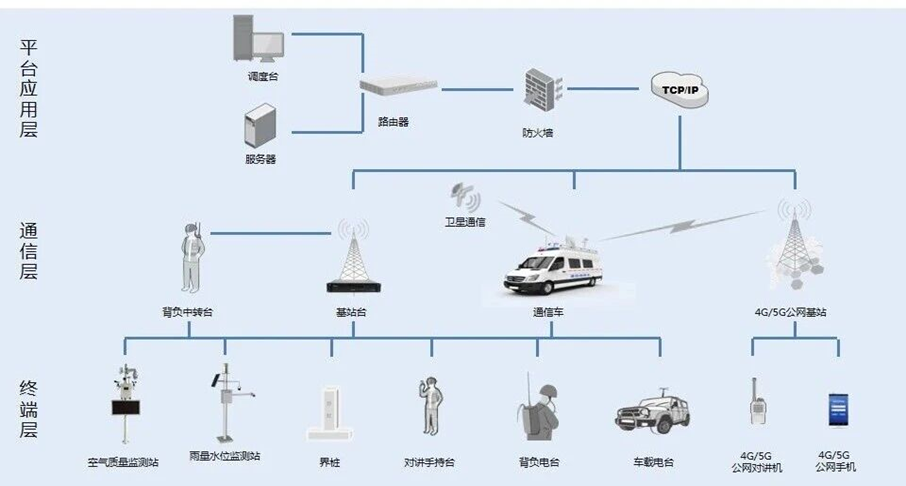
Terminal Layer
It includes water conservancy-specific radio terminals, river boundary monitoring terminals, and hydrological data acquisition terminals. These terminals are adapted to outdoor water conservancy operations and complex environments, featuring waterproofing, anti-interference, and low power consumption.
Communication Layer
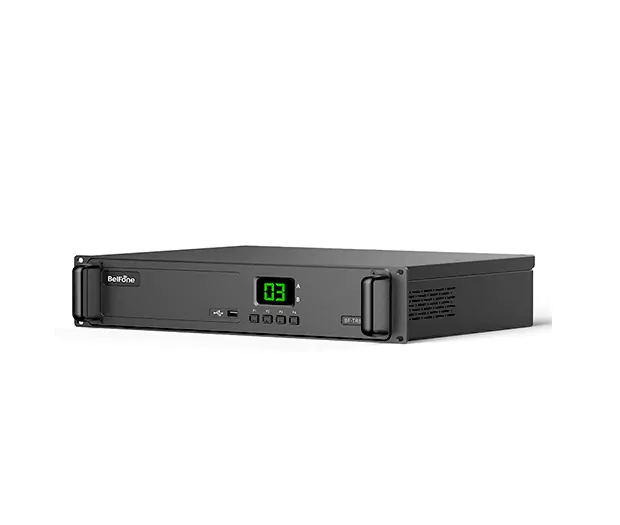
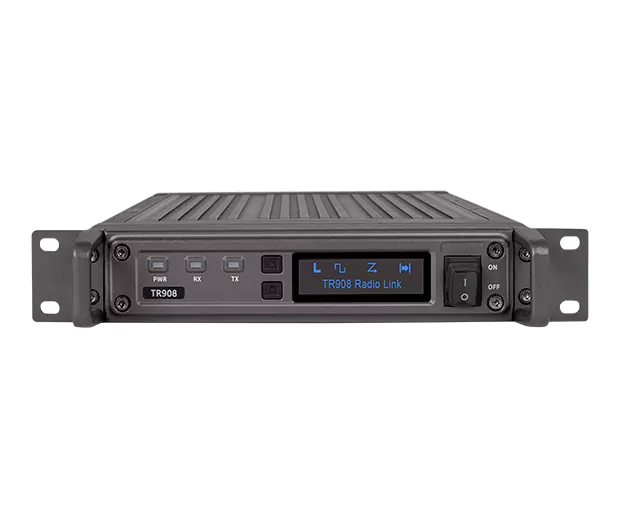
A "public network + private network" hybrid networking mode is adopted. In network-covered areas, high-speed data transmission is realized via 4G/5G public networks. In non-network areas, communication links are established through back-to-back technology of BF-TR8500/BF-TR908 repeaters, ensuring blind-spot-free communication across the entire region.
Platform Layer
Based on the SDC Intelligent Management
Communication System platform, it integrates functional modules such as GIS, dispatch management, data storage, and alarm handling. Adopting a C/S
architecture, it supports dual-end login for PC clients and mobile APPs,
enabling remote management and collaborative dispatch.

Solution Highlights
Based on BelFone SDC intelligent IP connect system, we build a dedicated command and dispatch system for water
conservancy, adapting to both daily inspection and emergency response scenarios:
Multi-Mode Communication Assurance
Supports individual call, group call,
all-call and other voice dispatch modes to meet various demands including
in-group communication for river patrols, cross-department collaboration, and
regional emergency notifications.
Integrates public network telephone and SIP device interconnection functions: the radio terminal can directly call the water conservancy department office line, and external calls can access the system to reach specific patrol groups or terminals, breaking communication barriers.
Hybrid Networking & Blind-Spot-Free Coverage
For public network-free areas such as
reservoirs and remote river sections, back-to-back repeaters are deployed.
Patrol terminal signals are relayed to network-covered areas via repeaters and finally
uploaded to the system platform, realizing full-domain communication in both
public network and blind areas.
Supports intelligent IP interconnection: during cross-regional dispatch, only relevant site repeaters are activated, reducing power consumption and interference.
Visualized Emergency Dispatch
Integrates GIS and terminal
positioning to display real-time locations of patrol personnel and emergency equipment. The dispatch center can quickly define rescue zones based on
incident locations and precisely dispatch nearby personnel and resources.
Supports dynamic time slot allocation to improve
channel utilization, ensuring smooth concurrent multi-group communication without
congestion during flood seasons and other emergency scenarios.
Remote O&M Management
Terminal parameters, channel switching and repeater
restart can be remotely configured via the backend, realizing over-the-air
programming and data synchronization for radios. This greatly reduces on-site
maintenance workload and improves management efficiency.
Application Value
BelFone Intelligent Water Conservancy
Trunking Communication Management System replaces the traditional manual
inspection and data collection mode, reducing on-site operation and maintenance
manpower input by 80% and cutting annual labor cost by more than 60%. Command
and dispatch efficiency is improved by 70%, with smoother cross-department and
cross-region collaboration. The emergency response cycle is shortened from
hours to within 15 minutes.
It improves management efficiency throughout the entire process, realizing full-domain communication coverage for perception, transmission and management. The system ensures the safety of inspection personnel and the rapid delivery of instructions in emergency scenarios, fully satisfying the performance requirements of all departments of the Water Conservancy Bureau and assisting daily office work.
Related Products



Technical support: Longcai Technology
