


How Antennas Affect Walkie‑Talkie Performance in Different Environments
release date:2026-06-29
The antenna is the most critical component of a walkie‑talkie, as it directly determines communication range, signal stability, and overall working efficiency. Poor communication quality is often caused by mismatched antennas rather than device faults. Choosing the right antenna according to the actual environment is essential to achieve stable and reliable radio communication.
Walkie‑talkie antennas are mainly divided into two frequency bands: UHF and VHF, each suited for distinct scenarios. UHF antennas feature shorter wavelengths and stronger penetration, allowing signals to pass through walls, buildings and obstacles more easily. They perform best in urban areas, shopping malls, office buildings, underground garages, and industrial parks with complex structures and many barriers. In contrast, VHF antennas have longer wavelengths and lower propagation loss in open spaces. They deliver longer communication distances and better diffraction in mountains, forests, open plains, and water environments, making them ideal for outdoor rescue, forest patrols, maritime operations, and fleet dispatching.
Antenna gain also plays a decisive role in practical use. Low‑gain antennas of 1–2 dBi provide omnidirectional signal coverage with uniform radiation in all directions. They effectively reduce blind spots in enclosed or complex environments such as buildings, tunnels, and underground construction sites, ensuring stable short‑range communication with high portability and durability. On the other hand, high‑gain antennas of 3–6 dBi concentrate signals horizontally to extend communication distance significantly. They work excellently in open areas such as highways, open fields, and large outdoor construction zones, but their narrow beam results in poor signal penetration in heavily blocked environments.
Special working scenarios require strict antenna selection standards. Construction sites need reinforced, bend‑resistant antennas to adapt to harsh working conditions. In explosive and hazardous environments such as chemical plants, gas stations, and coal mines, only original factory certified explosion‑proof antennas are permitted. Unauthorized modification or replacement will invalidate safety certification and cause potential risks. Digital walkie‑talkies with GPS functions must retain their original integrated antennas; otherwise, positioning and tracking functions will fail. In daily use, transmitting without an antenna or using mismatched antennas will cause signal reflection, damage the radio frequency module, and shorten the device’s service life.
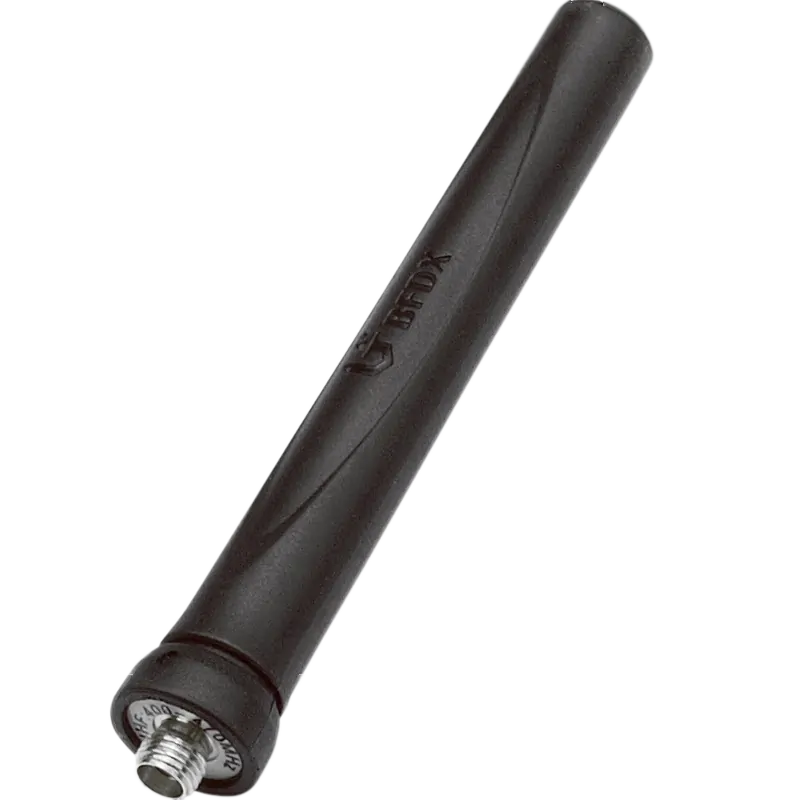
In conclusion, there is no one‑size‑fits‑all antenna for walkie‑talkies. The optimal choice depends on the working environment. UHF low‑gain short antennas are suitable for indoor and obstacle‑rich scenarios, while VHF high‑gain long antennas are preferred for long‑distance outdoor communication. Following scenario‑based selection and safety standards ensures stable communication, better usability, and long‑term device reliability.
Walkie‑talkie antennas are mainly divided into two frequency bands: UHF and VHF, each suited for distinct scenarios. UHF antennas feature shorter wavelengths and stronger penetration, allowing signals to pass through walls, buildings and obstacles more easily. They perform best in urban areas, shopping malls, office buildings, underground garages, and industrial parks with complex structures and many barriers. In contrast, VHF antennas have longer wavelengths and lower propagation loss in open spaces. They deliver longer communication distances and better diffraction in mountains, forests, open plains, and water environments, making them ideal for outdoor rescue, forest patrols, maritime operations, and fleet dispatching.
Antenna gain also plays a decisive role in practical use. Low‑gain antennas of 1–2 dBi provide omnidirectional signal coverage with uniform radiation in all directions. They effectively reduce blind spots in enclosed or complex environments such as buildings, tunnels, and underground construction sites, ensuring stable short‑range communication with high portability and durability. On the other hand, high‑gain antennas of 3–6 dBi concentrate signals horizontally to extend communication distance significantly. They work excellently in open areas such as highways, open fields, and large outdoor construction zones, but their narrow beam results in poor signal penetration in heavily blocked environments.
Special working scenarios require strict antenna selection standards. Construction sites need reinforced, bend‑resistant antennas to adapt to harsh working conditions. In explosive and hazardous environments such as chemical plants, gas stations, and coal mines, only original factory certified explosion‑proof antennas are permitted. Unauthorized modification or replacement will invalidate safety certification and cause potential risks. Digital walkie‑talkies with GPS functions must retain their original integrated antennas; otherwise, positioning and tracking functions will fail. In daily use, transmitting without an antenna or using mismatched antennas will cause signal reflection, damage the radio frequency module, and shorten the device’s service life.
In conclusion, there is no one‑size‑fits‑all antenna for walkie‑talkies. The optimal choice depends on the working environment. UHF low‑gain short antennas are suitable for indoor and obstacle‑rich scenarios, while VHF high‑gain long antennas are preferred for long‑distance outdoor communication. Following scenario‑based selection and safety standards ensures stable communication, better usability, and long‑term device reliability.
Accessories
Related Products





Technical support: Longcai Technology
