


How Do Walkie-Talkies Communicate Over Long Distances
release date:2025-12-25
Walkie-talkies operate on designated UHF (Ultra High Frequency, 300 MHz–3 GHz) or VHF (Very High Frequency, 30 MHz–300 MHz) bands, which are ideal for short to medium-range communication due to their ability to travel through obstacles or propagate through the atmosphere. For standard consumer-grade walkie-talkies without external aids, communication range is typically limited to 1–5 miles in open areas, as RF signals weaken over distance due to path loss—a natural attenuation caused by signal dispersion and absorption by buildings, trees, or terrain.
To extend this range dramatically, the most critical component is a repeater system. Repeaters are fixed, high-powered devices installed at elevated locations (such as hilltops, tall buildings, or communication towers) to receive weak signals from walkie-talkies, amplify them, and retransmit them at a stronger power level over the same or adjacent frequency bands. This “signal boost” overcomes line-of-sight limitations: when a user transmits a signal, the repeater picks it up even if the target receiver is out of direct line of sight, then broadcasts the amplified signal to cover a far wider area—often expanding the communication range to 20–50 miles or more, depending on the repeater’s power output and elevation.
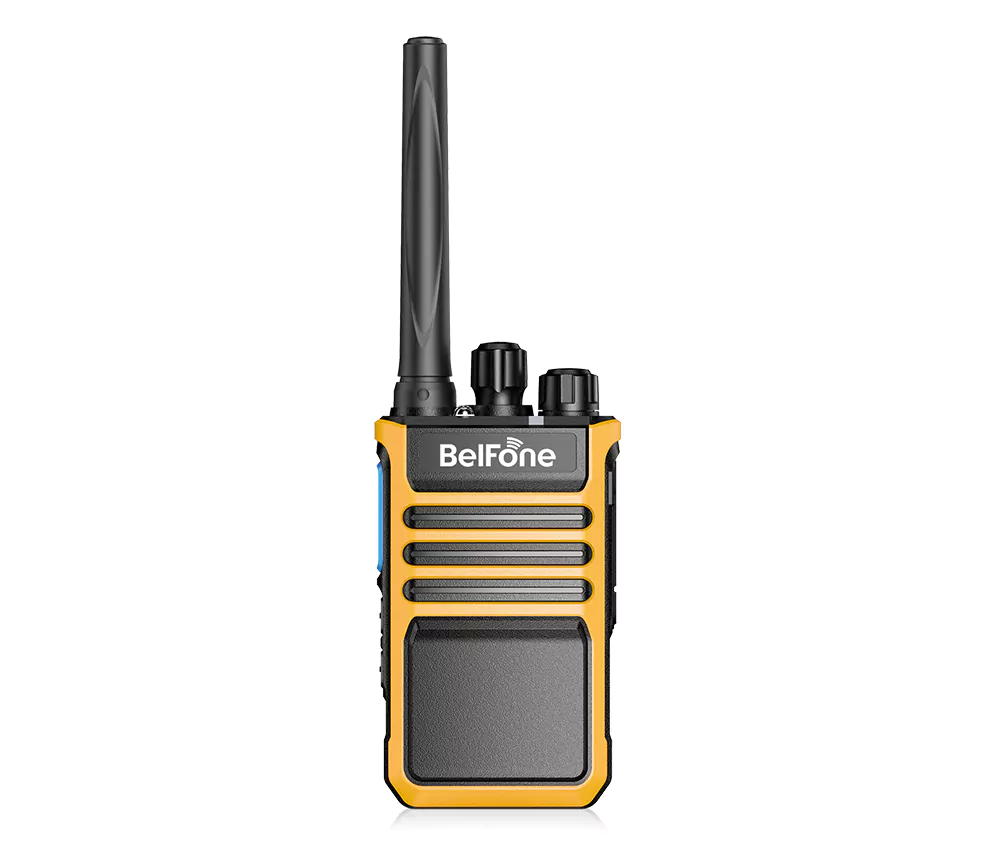
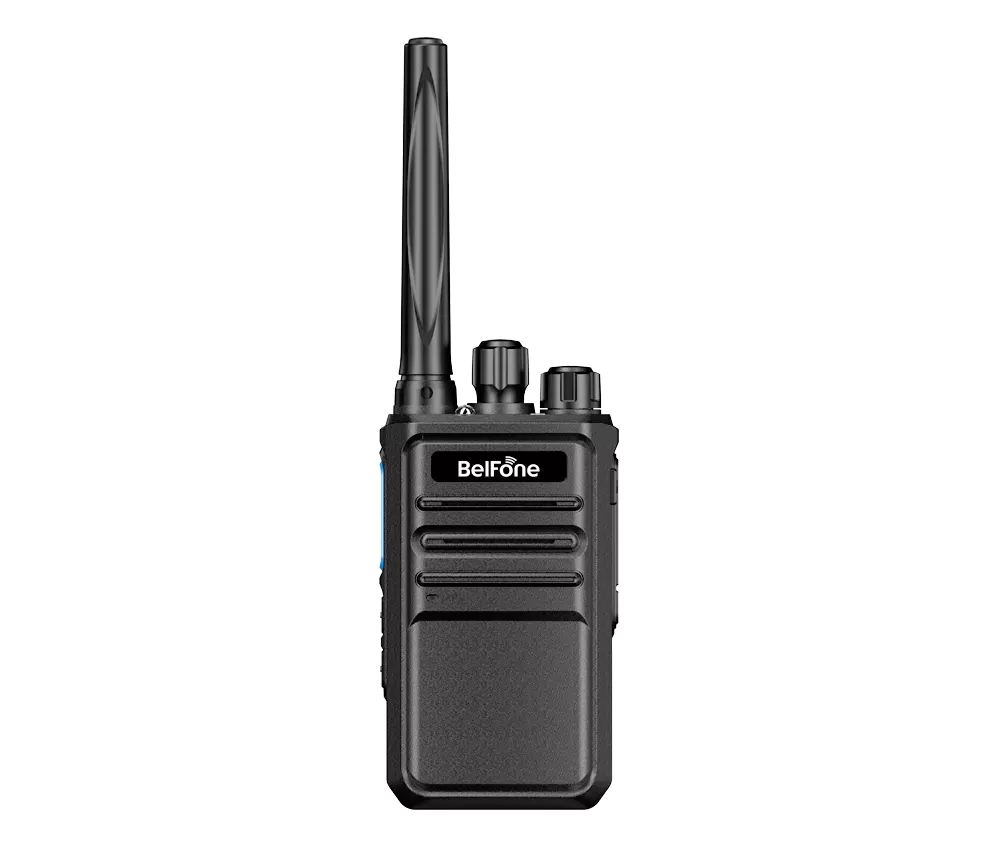
Another key factor for long-distance communication is the antenna design of the walkie-talkie. Upgrading from a stock short antenna to a longer, high-gain antenna enhances signal reception and transmission efficiency, as it can better capture weak incoming waves and focus outgoing signals in a specific direction. Professional two-way radios used in industries like public safety, construction, or logistics often come with detachable high-gain antennas to maximize range.
Environmental conditions also play a vital role. In open, flat terrain with minimal obstacles, RF signals travel farther with less interference. Conversely, urban areas with dense buildings or mountainous regions can block or reflect signals, reducing effective range—even with a repeater. Additionally, atmospheric conditions such as ionospheric reflection (more common in VHF bands) can occasionally extend range beyond normal limits by bouncing signals off the ionosphere, though this is less reliable than using a repeater system.
Finally, regulatory compliance ensures stable long-distance communication. Walkie-talkies must operate on licensed or license-free frequency bands allocated by local authorities (e.g., FRS/GMRS bands in the U.S.). Licensed bands often offer higher power limits, allowing for stronger transmissions that pair more effectively with repeaters to achieve extended range.
In summary, walkie-talkies achieve long-distance communication by leveraging repeater-amplified signal transmission, optimized antenna design, favorable environmental conditions, and adherence to frequency regulations—turning these compact devices into reliable tools for long-range, real-time voice communication across diverse scenarios.
To extend this range dramatically, the most critical component is a repeater system. Repeaters are fixed, high-powered devices installed at elevated locations (such as hilltops, tall buildings, or communication towers) to receive weak signals from walkie-talkies, amplify them, and retransmit them at a stronger power level over the same or adjacent frequency bands. This “signal boost” overcomes line-of-sight limitations: when a user transmits a signal, the repeater picks it up even if the target receiver is out of direct line of sight, then broadcasts the amplified signal to cover a far wider area—often expanding the communication range to 20–50 miles or more, depending on the repeater’s power output and elevation.
Another key factor for long-distance communication is the antenna design of the walkie-talkie. Upgrading from a stock short antenna to a longer, high-gain antenna enhances signal reception and transmission efficiency, as it can better capture weak incoming waves and focus outgoing signals in a specific direction. Professional two-way radios used in industries like public safety, construction, or logistics often come with detachable high-gain antennas to maximize range.
Environmental conditions also play a vital role. In open, flat terrain with minimal obstacles, RF signals travel farther with less interference. Conversely, urban areas with dense buildings or mountainous regions can block or reflect signals, reducing effective range—even with a repeater. Additionally, atmospheric conditions such as ionospheric reflection (more common in VHF bands) can occasionally extend range beyond normal limits by bouncing signals off the ionosphere, though this is less reliable than using a repeater system.
Finally, regulatory compliance ensures stable long-distance communication. Walkie-talkies must operate on licensed or license-free frequency bands allocated by local authorities (e.g., FRS/GMRS bands in the U.S.). Licensed bands often offer higher power limits, allowing for stronger transmissions that pair more effectively with repeaters to achieve extended range.
In summary, walkie-talkies achieve long-distance communication by leveraging repeater-amplified signal transmission, optimized antenna design, favorable environmental conditions, and adherence to frequency regulations—turning these compact devices into reliable tools for long-range, real-time voice communication across diverse scenarios.





Technical support: Longcai Technology
